Deciding who I need to collaborate with:
Once I had chosen the repertoire I will be playing, recording and performing, I started to think about creating an arrangement for Human Nature and for this to happen, I will need other musicians (who I will choose to collaborate with)to play parts on required instruments.
So far, I am collaborating with Joseph, Joshua, Mael, Feme and Victoria. I chose to work with Joseph because he is a very versatile player, with experience on the drums, saxophone, bass and piano as his fourth instrument. Joshua is a musician who does not attend Leyton Sixth Form College but has been asked to play in concerts performed by some of the second year students to play the bass. Due to this, I considered him playing the bass in some of my songs as he is an experienced player who I can give a chart to and start rehearsing as quick as possible. I would like to have a lot of time to rehearse my performed song 'Human Nature' because once we have created an arrangement, everyone knows what they are playing, there will be room for improvement where we can "tweak" a few things to make it our own. With time left over, I could work on adding "extra bits" to my trumpet part. This included doing my research, watching other trumpet and band covers of this song, improvising to create which will all help with the progression of my trumpet part. Another benefit of having a sufficient amount of time is that we will be fully prepared on the day of the performance.
There were some issues I came across when attempting to collaborate with some musicians. This occurred
with the pianist called Mael who I had asked to read a piano accompaniment from a score for Chanson Napolitaine. Before I went to ask Mael if he could play the duet from the score, I didn't know that he couldn't read the music. This was a mistake I made which I wanted to solve immediately.
This was easily solved as I asked another pianist from a different group on the same day and this was successful.
Even though Chanson Napolitaine is a piece I will be recording in the studio towards a backing track, I will be practicing with a live pianist for some of the rehearsals which will be evaluated below. This is the reason why I needed a pianist who can read from sheet music. The positives aspects of this were that whenever the studio was unoccupied, I could practice in another room with a piano with the pianist. This ensured that we kept to our timings and kept organised as musicians.
The only negative thing was that the pianist played in a different tempo to the original Chanson Napolitaine by Tchaikovsky. The tempo marked on the score is 96bpm for the first section and 128 bpm for the second section. During the rehearsal, the pianist played a slower tempo but still sped up the bpm for the second section as this was a comfortable speed for me to play at. This tempo was about 85bpm and 100bpm. This did not prepare me for playing to the backing track which is in the correct tempo.
I am going to solve this by researching how to play in a "fast" tempo on the trumpet as this is one of my difficulties.
How my arrangement is influenced by the genres present in Blue Bossa
As I talked about previously and based on my research (which I will back up with some more evidence, Blue Bossa is influenced by the musical styles of hard bop and bossa nova and jazz.
Carrying out research and gathering information from various sources, I found out that the instrumentation of a typical jazz standard (consisting of the bass, drums piano as the "comping" instruments) usually consists of a solo for all instruments. The comping instruments can also be called the rhythm section. The drummer is responsible for keeping the time so that the frontline instruments can follow and stay in time. The piano, which is another instrument within the rhythm section, is mostly present to support and accompany ("Comping" is the term used instead of accompanying in jazz) the frontline instruments.
When creating the arrangement for this song, I took into account of the influences which could make my cover of blue bossa greatly relatable to the original Blue Bossa track. I decided that a good way to ensure that my cover relates, in terms of sound to jazz, hard bop and bossa nova is to make use of the features of these styles of music sufficiently.
Context:The choice of drums for the backing track was a Latin Fire Percussion. This closely links to one of the genres which are present in Blue Bossa which is Bossa Nova, a style of Latin Jazz.

Latin jazz, also called Afro-Cuban jazz, a style of music that blends rhythms and percussion instruments of Cuba and the Spanish Caribbean with jazz and its fusion of European and African musical elements. This is what can be heard in the Latin fire percussion.
Instrumentation in jazz music was included during my studies of GCSE Music during secondary school. This is also where I was introduced to genres of music and how they differentiated. The set works that were included with the Edexcel exam board were Classical - Mozart Symphony no.40 Baroque - Handel and the glory of the lord,
the glory of the lord, Jazz- Miles Davis - All blues, African- Koko Yiri.
I backed this up by referring to some additional research sources research which I will I will compare due to the reasons that online information can sometimes be quite biased. Particularly, I will be researching into the instrumentation, using two different online sources which I will compare. I will compare the sources depending on their usefulness as to what I am aiming to find out (the role of the rhythm section in jazz music, what additional roles they may contribute to and some more jazz instrumentation terms).
The first research source I looked into is called 'Musical Threads in Early Jazz' by E/Prime Media & Randy Fertel, met one of my requirements which was to find out more about the rhythm section in jazz music.
At the bottom of the page, it mentions the rhythm section. The instruments which provide the rhythm for jazz music are the drums, piano, banjo or guitar. They describe the rhythm as steady and driving. In terms of music, steady could mean that everything will stay at one level including the volume, the way that the This rhythm section contrasts with the front line melodies in terms of their improvisation during the solo sections and the "polyphony of the group of melody instruments".
It then goes on to describe how these instruments can also have different roles with reference to some pianists. Pianists named Jelly Roll Morton, Tony Jackson and
Manuel Manetta have previously played as a solo instrument on some Jazz standards. However, when there were more instruments present, similar to a big band, they were often used as a supportive instrument.
This is the same occurrence for the guitar and banjo in terms of how they play in a band setting. A supportive role in music is providing an accompaniment to the music, keeping the time signature and bpm constant throughout the whole song,
A drum solo would contrast to the New Orleans jazz as during these times, drummers rarely took solos as they were counted on to keep time. In my version of Blue Bossa, the trumpet is the only instrument which will be playing an improvised solo.
The features of classical music
dynamics and articulation
dynamics and articulation
More variety and contrast within a piece:, tunes, rhythms and dynamics (now using crescendo and sforzando); frequent changes of mood
From Human Nature
In Chanson Napolitaine, there are various contrasting sections within the piece. The first I will talk about is the dynamics. I went through this topic in parts of my blogs in units 1-7 (I carried out a practice routine which focused on my dynamics on the trumpet with the help of researching)which has taught me more in depth about dynamics.
The dynamics changes which make up 'Chanson Napolitaine' are p(piano), pp, mf(mezzo-forte), f(forte).
I believe that the dynamics gradually build in this piece. I made this judgement because the dynamics pp(pianissimo), p(piano), mf(mezzo-forte) and f(forte) tend follow each other in an order in terms of the volume of sound. This judgement may change as I analyse where the dynamics are placed in the whole of the piece.
Dynamics refer to the volume of a sound or note played on an instrument or voice,they can be used in symphonies to popular music. They are usually indicated by printed letter markings on sheet music. Dynamics are based on Italian words rather than in English (e.g. quietly, softly). Due to this, I was taught by my trumpet tutors how to recognise different types of dynamics which I will put in with my research.
Dynamics offer a way to show expression in music add change of volume and intensity to music as some notes are supposed to be played more strongly whereas others, softly.
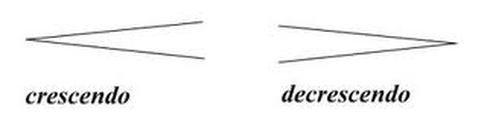 |
| http://blogs.yis.ac.jp/20songy/2014/10/07/music-class-review-melody/ |
Crescendo (cresc.): This means to gradually play louder shown in the image to the right.
Diminuendo/decrescendo (dim. or decres.) which is the opposite of a crescendo These both mean to gradually play softer.
Crescendos and diminuendos are different to the dynamic markings such as mezzo forte(mf) or forte(f) as they are gradually changing dynamics. mf( mezzo forte) would be the volume of the whole line/phrase.
The main dynamics levels are p(piano) which means to play soft or quietly. In contrast to this, forte(f) translates to the word "loud. Beyond p and f, there are also pp and ff. pp stands for pianissimo which means "very soft/quiet". 'ff' stands for fortissimo which means "very loud".
There are more subtle degrees or loudness and softness which are indicated by mp and mf. Mp stands for mezzo-piano which means "moderately soft and mf stands for mezzo-forte which means "moderately loud".
Once a dynamic marking is shown on a piece of music, the player is to play in that dynamic until another dynamic to be played is shown. Once a crescendo or diminuendo is marked, this must be spread across the length of the crescendo or diminuendo to show the gradual change across the line or phrase.
I have worked on dynamics for most of the previous units in a jazz standard (Cantaloupe Island) and pop music (Havana by Camila Cabello). This shows that dynamics can be evident in a range of genres but are used differently.
Dynamics are important because when they are put in place in music to give a little bit of character to the piece, making it interesting and worth listening to. If you had a piece that was all one dynamic, it would be the equivalent to a monotone speaker, which is very stale. With dynamics, the music becomes something that is more that text on a page, but something to enjoy. https://prezi.com/ow29j48x1ic-/the-importance-of-articulations-dynamics-in-music/?webgl=0(pianissimo) is present in the piece, the volume of ff(fortissimo) is not reached as the highest is f(forte).
These dynamic markings happen to be more common in the classical trumpet solos/pieces. On the website its says that the dynamics were of a larger variety in classical music than the other classical genres such as baroque, romantic and contemporary. (https://blog.sheetmusicplus.com/2014/05/29/musical-characteristics-and-performance-practice-of-the-classical-period/)
I will now talk about the process of making dynamic changes on the trumpet whilst evaluating my ease/difficulty with this.
The dynamic markings in the piece
As shown in the image to the side, the very beginning of the piece is in piano.
 This simple dynamic marking of playing quietly in piano is played throughout the opening of the piece or in other words the main idea. The dynamic marked as piano is only marked once as the whole 10 bars(the opening melody) stays the same volume until it is repeated...
This idea that the dynamics in the piece "gradually build" seems to differ when the main tune of the piece is repeated for a second time as it is played in pp (pianissimo). Therefore, it is slightly quieter than the opening of the piece. Again, 'pp' (pianissimo) is only marked once due to the whole of this section being the same volume. However, the piece only stays in pianissimo for the 8 bars of this repeat of the opening and never does it go to a volume quieter than p(piano) for the rest of the piece.
This is a large dynamic contrast to the next section which comes immediately after this which is in mf. This switch from pianissimo (pp) mezzo-forte (mf) means that the music "skipped" a volume of sound in between these dynamics which is p(piano). This is more of a contrast than a build up which contradicts the statement I made earlier about the dynamics in this piece "building up gradually".
When it is played on the trumpet, you should hear a phrase which is very quiet immediately followed by a phrase of greater volume so that there is a noticeable contrast for the listener.

As I previously mentioned, the next section of the music where it changes (these changes are differentiations in the melody with notes switched around and the note ranges). This section contrasts the section before this as it is now in mf(mezzo-forte) rather than continuing in pp(pianissimo). This dynamic change starts on the C# rather than at the very beginning of the phrase.
The section after this which follows is almost identical to the section which comes after where the only difference between these sections is a longer note at the end of the phrase. (timing)
However, in terms of the dynamics, this section is slightly louder than the previous section. The change from mf(mezzo-forte) to f (forte) is just a small difference in volume between these sections however, it did build up instead of contrasting in volume by a large amount.
This could be building the anticipation for what is going to come next, increasing the way the dynamics contrast.
 Surprisingly, the next section which is a change in the music changes in dynamics with a few aspects of the music changed as well. Firstly, the tempo(bpm) has changed from 96 bpm to 128 bpm so this section is much faster than the rest of the piece with shorter note durations.
The dynamics do contrast in this section with the previous section being in forte with a change to piano which I believe is sufficient differentiation from loud to soft. (I can also back this up). Piano can be described as... and Forte can be described as...
Afterwards, the piece is coming to an ending where the beginning of this section is the same as the previous section. However, this repeat is louder than the previous section, in mezzo-forte.
As shown here, the music gradually gets louder as the piece comes to an end. This contrasts to the beginning which is piano(to forte) as the music is now in forte with a "loud" ending. The marking of the forte dynamic begins on the first note of bar 51 which means that this note is to have the most volume of sound than the other notes before it(a descending sequence).
Articulation is something I have been taught during my years of private trumpet lessons and studying music for GCSE. During this, I have learned how to apply articulation to my trumpet playing including playing in legato or staccato depending on the context/genre of the music I am playing. In Chanson Napolitaine, which is the classical piece I am doing, uses articulation on a different way to the way jazz and 'human nature' (quiet storm, rhythm and blues and soft rock) use articulation.
However, this can also be something that I tend to struggle with when playing certain pieces due to the technique it requires. In Chanson Napolitaine, the articulation on the quavers are slightly more difficult due to the "fast" tempo which changes from 96bpm to 128bpm (where there is more articulation). This is why I have chosen to focus this research specifically on articulation.
However, this can also be something that I tend to struggle with when playing certain pieces due to the technique it requires. In Chanson Napolitaine, the articulation on the quavers are slightly more difficult due to the "fast" tempo which changes from 96bpm to 128bpm (where there is more articulation). This is why I have chosen to focus this research specifically on articulation.
To begin this practice routine I decided to do some research on how articulation is used in music.
Knowing when to play notes short or long, playing melodies gently or boldly is all controlled by articulation. In classical music, especially in Chanson Napolitaine, there are more accents and staccato's. This means that most of the notes are played boldly as an accent is when a note is played with extra "force". In Chanson Napolitaine by the classical composer Tchaikovsky, there are no phrases which are slurred but there are some notes which are joined together especially in the first page. To conclude this explanation, Chanson Napolitaine is more of a strongly articulated classical piece with loud and soft moments (in dynamics).
The definition of articulation is the way a note or passage is played on an instrument or sung by a vocalist.
In this video of a student playing this piece in preparation for a grade 6 exam.
In this video, the playing starts off with a brief chat to begin with. This is where the teacher and the student are explaining the uses dynamics and articulation in Chanson Napolitaine.
In terms of the dynamics, what I talked about previously, they say that "the piece starts quiet but then gets even quieter to pianissimo and it gradually builds towards the end". This relates to what I talked about which backs up my research and also justifies my interpretations about the piece because I also said that the piece builds up in volume. I also said where there were points that contradicted this statement and parts where this statement was supported such as when a piece is quiet and getting quieter, this is not particularly "building up".
Sticking with the main idea of this research which is articulation, in the video, they say that the articulation in Chanson Napolitaine is more important that the dynamics. This is because there is a significant amount of articulation which features in this piece. When there is a lot of articulation in a piece, whether this is used or not could make a big difference to the music. If I played Chanson Napolitaine without all of the staccatos and accents which are marked on the piece, it wouldn't sound like I am playing in the style of classical music that Chanson Napolitaine is which is why the articulation is an important part of the song.
However, going against what they had said in the video about the articulations being more important that the dynamics, I think
I researched this on google to find some information to back up my judgement. What I found relates to the context of the piece, the composer, Tchaikovsky.
Tchaikovsky uses ppp and fff to emphasise important moments. He even uses pppppp for a bassoon solo in his sixth symphony, The Pathétique. Holst uses ffff in “Mars” from The Planets. Even thought the dynamics here are much louder than those present in Chanson Napolitaine, from this, you can tell that Tchaikovsky uses dynamics for PURPOSE. He doesn't just put in the dynamics so that you can choose whether to play them or not. The importance of dynamics in Chanson Napolitaine is how the dynamics gradually build up with some parts which decrease in volume is significant in the way the song sounds.
Back to the articulations used in the piece, the teacher says that it is all about using your tongue for the staccato notes as there is "lots" of staccato in this piece. They also mention there are a lot of accents. They also mention how Tchaikovsky didn't make use of much legato in this piece. Legato means that the notes are smooth and connected without breaks between the notes played. I simplified a definition I found in the dictionary.com.
A song which I mentioned earlier on in the blog called Don Pasquale is a classical piece composed by Donizetti is more suited to the legato feel. This can be shown by listening to the video below.
Composers and arrangers provide articulation directions in the form of written notation, symbols placed above or below notes unless the articulations are created by ear. In this case, I learned Chanson Napolitaine by reading the score, visualising the written notation of symbols placed above and below the notes. Some examples of where this is shown are in the images below. The markings are placed above the notes here.
In Chanson Napolitaine, the staccatos are marked above the notes in the higher pitches
In Chanson Napolitaine, the staccatos are marked above the notes in the higher pitches
To improve my articulation specifically, I have focused on the second part of the piece where there are more staccato notes because I have to work really hard here to get the notes (that are really close together) sounding separate from each other (this is how staccatos are supposed to sound). Other than this particulation, I also focused on the rest of the piece where they were some other articulations such as slurred notes.
A slur is a musical notation that informs the musician to play a sequence of two or more notes without pausing in between notes, like slurring all the notes together. On the trumpet, you simply blow through without tonguing any of the notes in that phrase.
A slur is a musical notation that informs the musician to play a sequence of two or more notes without pausing in between notes, like slurring all the notes together. On the trumpet, you simply blow through without tonguing any of the notes in that phrase.
In this practice routine, my ability to articulate notes well during a piece improved and my articulations were more noticeable Before, I was articulating but I wasnt doing it properly so it was hard to notice that I was articulating.
I would like to work on discovering pieces with much more difficult articulations and learning how to play these. This will make sure that I get practice with most types of articulations in trumpet music, broadening my technique.
I enjoy playing this piece, it is classical and this piece has a greater meaning when played strongly with the articulations. When I play the piece with more articulations, I feel like I am expressing the notes more.
Some articulation like bowing and plucking marks for strings is exclusive to specific instruments which is not relevant for my purpose of research.For example, seeing the abbreviation pizz. on the music means pizzicato, (pronounced pit-si KA' toe) which signals to pluck rather than bow the strings. Seeing the word arco means to return to normal bowing methods. Brass and woodwind players would never see these markings on their music! This will not be found on music written for the trumpet so we'll put this aside for now.
Other markings and notations are used for all types of music and instruments. The articulation could be marked on single notes or for a longer passage of music.

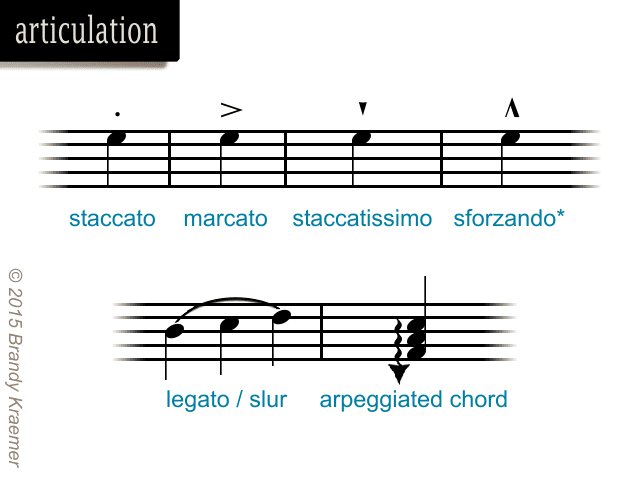
The image to the left shows marks for 5 different types of articulation.
At the far right, a line over or under the body of a single note means it is to be played tenuto (ten-U' toe) or held to its full value. This full value will depend on the type of note it is and in this case, the note is a minim which means it should be held for 1 whole beat. The transition between notes which are market with tenuto should be played more legato than normal. You can think of a tenuto as the opposite of a staccato where you play the note slightly shorter than the actual value. This type of articulation is not evident in Chanson Napolitaine therefore, I will not elaborate further with this.
The note with an arrow on top of it is called an accented note. This means that the note has a stronger attack on it and is played with more emphasis than a normal note.
The difference between the way I would play accents and staccatos is mainly based on the amount of air used through the instrument. Accents are more prominent and loud which means that the air need for these notes are an increased amount. To do this on the trumpet, lots of air need to be in the lungs which means taking in a huge breath. However, staccato notes can be played staccato without the volume changing whether the note is a staccato note is it is purely focused on the use of the tonguing in the instrument. This will depend on the dynamics marked. If there is a pattern of staccato notes in Chanson Napolitaine, the staccato notes will be played softly or loudly. Near the beginning of the piece, there are staccato notes when the tempo is pp(pianissimo) which means very quiet. This is in the image of the score below. This justifies my statement I I just made.

A lack of practice will cause the player to have a more difficult time producing sound through the instrument, resulting in more problems with articulation. I was advised to practice my trumpet daily a few years ago, to improve further(with my articulation).
To maintain sufficient sound, technique, and articulation while playing, one is advised to practice the fundamentals of playing. There are many different exercises that can be used to improve the basics of playing. Every player has his or her own preferences on what the best way to warm up is. Long tones, scales, and technical exercises are generally recommended at the start of a playing session. Doing so helps the player build and maintain skills (“Second Book of Practical Studies for Cornet and Trumpet”). As with many other activities, starting small is a much smarter idea than trying to jump into more complex things first.
 One way I can do this is playing the page of the piece with the most articulation in a slower tempo rather than playing in 128bpm (the original tempo). This will get me used to the articulation and I will also play with a metronome so that I can start at 80pm, for example and then gradually increase this tempo of speed.
The note with an arrow on top of it is called an accented note. This means that the note has a stronger attack on it and is played with more emphasis than a normal note.
A single dot above or below the body of a note means it's staccato, or short and separate.This probably comes from the word staccato as it sounds edgy and precise. Staccato is like the opposite of tenuto. For extremely short notes, a mark that looks like a triangular wedge or exclamation point without the dot is called a staccatissimo. It's even shorter and edgier than staccato.
To play an accent on the trumpet, this is mainly depending on the air flow. For the note to be heard with a stronger attack, the air needs to leave the mouth in this way. There needs to be a lot of air to achieve a stronger attack and the note needs to be 'tongued'. Tonguing in trumpet playing is when you use the tongue to play a note, forcing the tongue forward at the beginning of a note so that it reaches the opening of the mouth. This is to be done simultaneously as the air is passing through the instrument. To create a perfect staccato note, I breathe in a lot of air and use the tongue to punctuate the note as I blow the air through the instrument. The speed of the air will depend on the pitch of the note higher pitches require faster air speed whereas lower toned notes require a slower speed. The difference between the way I would play accents and staccatos is mainly based on the amount of air used through the instrument. Accents are more prominent and loud which means that the air need for these notes are an increased amount. To do this on the trumpet, lots of air need to be in the lungs which means taking in a huge breath. However, staccato notes can be played staccato without the volume changing whether the note is a staccato note is it is purely focused on the use of the tonguing in the instrument. This will depend on the dynamics marked. If there is a pattern of staccato notes in Chanson Napolitaine, the staccato notes will be played softly or loudly. Near the beginning of the piece, there are staccato notes when the tempo is pp(pianissimo) which means very quiet. This is in the image of the score below. This justifies my statement I I just made.
A lack of practice will cause the player to have a more difficult time producing sound through the instrument, resulting in more problems with articulation. I was advised to practice my trumpet daily a few years ago, to improve further(with my articulation).
To maintain sufficient sound, technique, and articulation while playing, one is advised to practice the fundamentals of playing. There are many different exercises that can be used to improve the basics of playing. Every player has his or her own preferences on what the best way to warm up is. Long tones, scales, and technical exercises are generally recommended at the start of a playing session. Doing so helps the player build and maintain skills (“Second Book of Practical Studies for Cornet and Trumpet”). As with many other activities, starting small is a much smarter idea than trying to jump into more complex things first.

No comments:
Post a Comment