Creating the performance set-list
In the afternoon the day before the performance, we created a setlist for the performance. This was done by having a discussion and getting opinions from the members of the group participating.
We sat down and firstly we discussed the opening and ending song. Someone said that we should open and end the performance with an "up-beat" song. Kitch, the rapper, has 2 songs which are "up-beat" and one which is a "slow tempo" song. The two 'up-beat' songs are 'Set the Standard' and 'Grind never Stops'. However, This decision was made by taking into account of further factors.
The 'Set the Standard' track contains lyrics created by Kitch which relate to the beginning of a performance. The lyrics 'set the standard' is like Kitch is setting the musical standard for the rest of the performance. This relation between the lyrics and the circumstance creates a significance to the performance.
Evaluation
What didn't go well when we were deciding on the order of songs in the setlist were that we noticed that there was a greater amount of slow songs in the set-list than we had expected there to be. The songs by Adele which will be performed by Bethany are moderately fast. This means that they are not too slow or too fast. The duet between Kitch and Nyah is a slow rap song and
This amount of slow songs in the setlist make is difficult to have a contrast with fast and slow songs. Some of the people in the group suggested that we have "one slow song and then one fast song". This would have been possible if the amount of "slow" and "fast" songs were equal numbers. We defined the tempo of the songs by saying whether they were "slow" or "fast" to simply differentiate them. However, it happened to be that the majority of the songs are the 'tempo' which is not "ideal" for a setlist.
This could be due to the performers not taking into account of the setlist during their preparation for the performance, choosing their repertoire. It could have been that we were very much focused on our own project.
Another reason why I think that the musicians were all focused on their own project is because some people didn't have consideration of the amount of songs in the set-list. The amount of songs in the setlist could affect the time that the performance would run on for. The performance is supposed to last from 7:30pm to 9:30pm. The amount of songs need to be a reasonable amount so that the worst doesn't happen.
If there are too many songs in the setlist, the performance may run over, resulting in the audience getting "bored" of listening to repertoire for two hours.
Together with this, another negative aspect of the performance running on is not having enough time to do the get-out at the end of the performance (this is when we will move all of the equipment back into the rehearsal room.
Back to my original point, the reason why I said that some of the musicians didn't have consideration is because Kitch, the rapper is performing 3 songs in total. Everyone else in the group is doing 1 or two songs, so, the number of repertoire comes up to 11. However, we are not the only group who are performing in this performance on Tuesday. There are two other groups, one with 10 songs and the other with 6 songs.
The major thing that could go wrong here is the audience loosing interest which was mentioned various times during the discussion.
The only way we can solve the problem of having "too many slow songs" is creating an interval for the other groups to perform in the middle of our setlist or having to put two slow songs together. We took into account of these two options in the creation of the set-list.
The final version setlist is listed below.
Some things that were changed is the position of Human Nature Before, Human Nature was placed as the fifth song in the list before the interval. However, this leave 3 "slow" songs to be played before a faster tempo song (Human Nature). Therefore, as Human Nature is my song, I decided to put it after the first slow song that is going to be performed (at the very start of the performance as we are opening it) so that the up-beat feel can keep the audience engaged in the performance.
I did some research on this to find out more about the engagement of audiences.
When speaking to the audience to open my song, I should tell a story to the audience to get their attention again after they have been watching for half an hour already. My story should be interesting and have some emotion connected to it. In my short story opening to the audience I can talk about how I discovered Human Nature due to it being such as well-known song. I will talk a bit about the artists who influenced my version.
This will be my opening speech to the audience:
Hi everyone, I hope you're having a fantastic evening. Today I will performing a well-known song by Michael Jackson called Human Nature! Miles Davis, a trumpeter who inspires me, influenced my version of this song in various ways such as using a bit of improvisation on the melodies. However I will be playing it on the flugelhorn which is very similar to the sound of a trumpet. I hope you enjoy it.
Getting the audience involved.
This website says to find ways to encourage participation in what you’re doing, whether that’s during some of your pieces, or in between, or both. This is something which Kitch, the rapper has incorporated into his performance of 'The grind never stops'. He does a gesture to the audience during the chorus with lots of energy to get the audience to copy this and so the gesture with the energy that he has.
The final performance set-list:
- Set the standard - Ktch
- When we were young - Bethany
- Human Nature - Me(Omega)
- Time - Precious
- Kitch and Nyah duet
- One and only - Bethany
Interval of the other songs performed by the other music students.
- Shackles - Mael
- Dionne and Mael duet
- Isn't she lovely - Ayeisha
- Grind never stops -Kitch
As evident we split our setlist in half to allow space for the other music students to perform their songs. This will be 16 songs before we come in again with Shackles.
This is what the completed Blue Bossa track looks like on Logic with the Latin fire percussion, finger style electric bass, the classical electric piano and the audio of the trumpet head melody and solo section.

My soundcloud page
My soundcloud page is where I uploaded Blue Bossa and Chanson Napolitaine. The link to this is below.

Links to my songs
Performance evaluation SOLAR 12TH JUNE
Today, the 12th June, the performance of Solar took place where I performed my trumpet cover, 'Human Nature'. This is where I put in all of my research, improvements for my version of 'Human Nature' to be a success.
I will be evaluating the things that went well before the performance (the get-in), during the actual performance, the get-out of the performance and the positives and negatives of my 'Human Nature'.
An advantage of the auditions fr featuring in 'Identity' is that I will have the opportunity to perform as a support act, performing 'Human Nature' again which will follow up from my evaluation of Solar.
An advantage of the auditions fr featuring in 'Identity' is that I will have the opportunity to perform as a support act, performing 'Human Nature' again which will follow up from my evaluation of Solar.
What went well with the Get-in:
As soon as the group were instructed on what to do, action was taken straight away. We were instructed to move all of the equipment, some eliminated such as the bass amps/microphones into the practice room and not into the theatre yet.
Due to this, the get-in didn't take a lot of time as everybody knew what they which made the job run quickly and smoothly.
This took place after the trial performance that we had and acted as a "get out". The get-out is the opposite to the get-in and this when we take all of the equipment out of the venue and put it where it is supposed to be. The get-in is when all of the equipment is brought into the venue. Eventhough the equipment wasn't brought straight into the venue, it was still the first time that we were moving the equipment.
This can prepare us for the get-out as it was in the same order as the get-in would be. This good organisation and preparation can influence the real thing of when we as musicians come to do get-ins and get-outs in the music industry.
The song Human Nature which I performed:
Evaluating me:
What went well:
In this performance, I remembered more from what I did in the rehearsals and didn't forget them like the last trial performance or rehearsals. I made a plan and research specific elements of my performance such as contrasting in dynamics, improvising with the melodies in Human Nature. This meant that I achieved what I was trying to achieve with my Human Nature.
In this performance, I remembered more from what I did in the rehearsals and didn't forget them like the last trial performance or rehearsals. I made a plan and research specific elements of my performance such as contrasting in dynamics, improvising with the melodies in Human Nature. This meant that I achieved what I was trying to achieve with my Human Nature.
In terms of the dynamics in this song, I played quieter in the verses. When it got to the second line of the verse, I used a crescendo up to the highest note of these lines. This is when the vocalist sings "sweet seducing sighs" in Michael Jackson's version. This is what I originally planned for my song.
At the end of the song, I ended in mf which was not what I had originally planned to do but it sounded good anyway, sometimes I like to be spontaneous with things which don't make a huge difference. Because this is the end of a chorus, I thought that I was going to end in f(forte) which means loud.
In the past, with my performance of 'Cantaloupe Island' in units 5-7 I didn't do a verbal intro. Due to this, the audience didn't know what the dong was called or another information on the song. This is not the only thing which was affected as verbal introductions engage the audience for the performance and created anticipation for what's to come. The anticipation is created because the audience gets a 'glimpse' of what the song is about and if it is a song that the audience already knows.
A song that has an interesting story will create anticipation of they would want to know how this story relates to the audience. The story will also grab the audiences's attention after hearing many songs in the setlist which could have made their attention drift away to somewhere else. Therefore, there are many positives to doing a verbal intro before a performance to engage the audience into my performance.
I did a verbal introduction for my 'Human Nature' where I said what the song is called and who the artist of the song is. Saying that "I will be performing a well-known song by Michael Jackson" would quickly engage the audience as most people already know this song due to the famousness of it. The audience would then have interest in the performance instead of playing the straight away, this way, I am preparing the audience for a good performance. Also, I mentioned that the song is going to be played on the flugelhorn. The original song is sung by the famous vocalist, Michael Jackson, therefore, the instruments contrast here, giving a different sound which should interest the audience to hear.
This was my first time with doing a verbal intro before a performance and it was a good experience. Overtime, I will improve these verbal introductions the more I perform. My tutors were telling my about attending open mic nights to increase the amount I perform which can build my confidence for performing and get me used to this.
I reached all of the notes in the higher octave without splitting the notes. This would have occurred when I go up to the F sharp at the end of the second line of the each verse. The cues of this in the vocal part would be sweet seducing sighs, then let me take a bite, she likes the way I stare and I'm dreaming of the street. If you listen to Michael Jackson singing this, you will notice that the pitch goes higher when he is singing these notes. The video is below.
Also, I am playing in the same key as Michael Jackson's version, therefore, the notes will be the same. This key is D major.
I believe that this success with the higher notes was because I used transposition earlier on in the project to make sure that I am comfortable with the key. Therefore, this key change ended up resulting in a positive outcome with clear 'high' notes.
I also had a good posture when playing which has an impact on the air flow. The air needed for higher notes is to be fast and supported. When the air flow is free to flow and is not trapped when the shoulders are too close together or when the body is in a hunched over shape. I stood tall with my shoulders back and held the instrument with the arms a reasonable length apart from each other which means that the airflow wasn't trapped causing reduced air.
In this performance of Human Nature, I moved slightly more than I did in the other rehearsals where I was very still. In the rehearsals, there was hardly any movement from the main instrumentalist which was me, playing the trumpet.
The advantages of moving during a performance is that it gives off a positive, enjoyable atmosphere to the music. This could be passed on to the audience as they will be able to see that the instrumentalists are enjoying the music, enabling them to get engaged with this. If there was a performance where all of the instruments looked uninterested in the music with no movement, this would give a negative vibe to the audience and they wouldn't have a "feel" to the music.
This research I did which will be below helped my explanation.
The visual experience of a musical performance can play an important role in our appreciation and perception of music. Many of us spend considerable time and money to see live performances rather than simply listening to CDs , which offer repeatable listening and higher sound quality.
"Davidson found that the expressive intentions of musical performers are carried most accurately by their movements. She used a point-light display to present subjects with recorded performances of classical musicians. The performers were instructed to perform in one of three ways: in a deadpan manner (without expressivity), in a standard manner (as if performing to a public audience), and in an exaggerated manner (with ex- aggerated expressivity). Subjects rated each performer’s intended level of expressivity. Those subjects who only saw the video identified the different levels most accurately. Subjects who were denied the visual information performed more poorly at deciphering. This study shows that not only is the visual aspect of a performance not superfluous, it carries information about expressive intention, with greater resolution than the auditory component."
During some rehearsals and practice sessions I hadn't started Human Nature "confidently". What I mean by this is starting the first note how it is supposed to sound. I started the first note as a staccato. This was previously a split note so there was some improvement here. The main problem here was my lack of evaluation on the stage which I had solved earlier on with breathing techniques before the rehearsal. Also, I had 2 rehearsals before this where I got warmed up which resulted in a "strong, confident sounding" first note. The first note I play is a B this will be evident in the video at the end of the evaluation.
This means that I have found ways to improve my splaying in the smallest ways, I will continue to use these current strategies for future performances, until I find better strategies.
What didn't go well:
- Little mistakes, focusing on the audience more than my own playing, causing me to "slip up" on a few notes
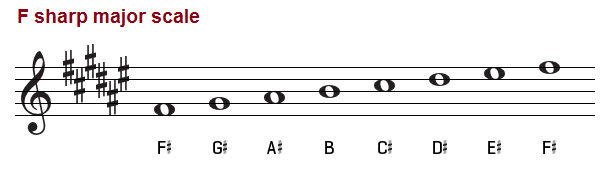
During Human Nature, I was surprised at where I made small mistakes. I would have expected these mistakes to be on the notes in the higher octaves such as the 2rd octave F# which is the top note of the scale below.
I don't think this occured due to my technique because I had done rehearsals of 'Human Nature' with less mistakes than I had made here.
This issue could be the impact of my lack of confidence/nervousness on stage. I also remember that I was focusing on the audience more than focusing on my own which resulted in my confusion at some points. I hadn't forgotten the notes but I had stopped breathing properly and when this is done, air cannot be passed through the trumpet, the thing that is necessary for producing the sound from the instrument. I learnt about this issue in my unit 7 practice routines.
- When I extended the song in the rehearsals, it didn't seem very repetitive as I had more ideas coming in to the music. In the performance this wasn't properly put into my playing.
Linking to what I talked about above about my mistakes and "slip ups", this also made me forget about my playing as my focus was elsewhere.
In the rehearsal a few days before, I had lengthened my song as I thought it was too short for a Human Nature. The length of the song came up to 2:53 which is an appropriate length for a 'Human Nature. I got this from my research I did into the genres present in Human Nature where I explained about a song which is too long "exhausting its potential" through the repetition of verses and choruses.
In the rehearsal, I kept on adding new ideas, experimenting and being spontaneous at some points. This was good but I should have kept this on for the actual performance. During the performance I played the verse the exact same about three times which I think is too much repetition. The choruses were also the same except from the contrast between staccato and legato in the chorus on the words 'why,why'. The real issue here is that I was giving it more in my rehearsals than the actual performance.
I also paused at some points when I made a mistake together with the outro. I stopped at the outro as I thought that it came earlier than I had expected it to.
I still made it obvious to the audience that I had made a mistake by stopping my playing in the middle of a verse or chorus. I tried to cover this up by smiling. This was supposed to be an improvement from my last performance. I asked someone this after the performance and they said that it was quite noticeable.
I didnt remember much things when I was on the stage which was caused by a lack of focus.
How will I improve my future performance:
I have another performance coming up on Thursday 14th June where I will take on these improvements will be a support act for the second year's show called Identity. After the auditions took place, they picked me to feature in their songs.
I would like to have backing vocalists (2) to double up the melody in the chorus. from 'Why, why' and 'Tell em that its Human Nature'. I tried this in the rehearsal before the performance. We gained feedback from this where my tutor said that I shouldn't have backing vocalists as it hasn't been prepare, they don't know what they're doing therefore this could have ended up being a fail if they were on the stage. There is an advantage of eliminating the backing vocalists last minute here.
Following up in 2 days for identity, I will practice daily and have rehearsals twice a day with the lighting to get me used to the performance atmosphere.This may work ease my nerves and increase my relaxation for the performance. Resulting in less of the issues (mistakes and "slip ups") which were caused by the nerves and lack of confidence I had on stage.
Even if I do make a mistake, I will prepare for this and not be completely ignorant and think that mistakes are impossible because they aren't. I will deal with any mistakes I make in Identity by just continuing to play, brushing past it because I won't be able to change what I had just played, I can only change what I play from there with a strong ending.
In the rehearsal before the next performance, I will make sure that I practice my movements. I should practice moving my head between the lines where I am not playing. It is quite difficult to move the whole body when playing the trumpet, however, this comes with technique and I am not quite there yet. I will also try to smile more at the audience. I will not be doing a verbal intro at the beginning of this performance as one of the second year students are introducing all of the 1st year support acts.
Evaluating the others taking part in the performance, the bassist, drummer and pianist:
The other instrumentalists of the group did really well, hardly any wrong notes were played and if they were, they were unnoticeable as they are not doing the main part of the song therefore, it is more unlikely to be heard than my mistakes.
Eventhough I made some mistakes during the performance, the others didnt take this into account and they carried on as normal and remembered all of their parts, the structure of the song which I reminded them of in the rehearsal.
Due to the my research into the context of this song, the style of this music is to be played moderately fast. This means not too fast and not too slow. I would say that the musicians played at a reasonable tempo. However, the only thing is that during the rehearsals, the pianist started with the piano introduction a bit slower than usual which made the rest of the instrumentalists (bass and drums) play slower for the rest of the song too.
I prefered the tempo that they played during the actual performance as this was comfortable with me and fitted with the genre (moderately fast) but they should have done this during the rehearsals and not just in the performance. This is an issue because I, as a trumpeter, need to know the tempo I am playing in and this can't keep changing as it can get confusing.
The drummer in this genre is responsible for keeping the "time" (time signature), keeping everybody in time with each other. His role was done well. Especially when I was using syncopation in the second phrase of the verse when Michael Jackson says "Into the night time", I listened to the drum beat and knew exactly when to play that syncopated note due to the constant, driving pattern of the drummers rhythm, like a riff in jazz, which is repetitive, but we won't go into that.
Perhaps, the pianist was 'rushing' because he was nervous and wanted to get the song finished which turned out to be an advantage in the long run.
At the beginning of the performance, the bassist didn't tune his bass before the performance which affected the intonation. However, this wasn't particularly noticeable as said by one of the audience members. The cause of this was that the bass player didn't know the setlist and that Human Nature was the fourth song. At least he was backstage and got onto the stage straight away but the bass wasn't tuned...
What can be done to improve:
For the next performance, I will advise the bassist to tune the bass before the audience start coming into the theatre. Because the performance starts at 7:30, the audience will start coming in at around 7pm. Therefore, he should tune his bass between 6:30 and 6:45 to leave him enough time. I decided on this because I learnt in units 1-7 that sound checks and tuning and all that jazz should be done before the audience come in to prevent them from hearing unpleasant sounds from the bass amp, for example. One of the unpleasant sounds is called feedback which is a sound very annoying for the ears.
I put all of the improvements I said I would do into this performance as a support act for Identity. Here is the video with my improvements evident.
I put all of the improvements I said I would do into this performance as a support act for Identity. Here is the video with my improvements evident.
The end.


