Evaluation summary of my playing of the Cantaloupe Island Jazz standard to compare to how I am going to play Blue Bossa, both jazz
During the performance, I felt like the pianist was playing too slow and it was a different tempo that what we did in the rehearsals. This resulted in me (on the trumpet) playing slower and playing longer notes during my improvisation section.
To improve this, the drums could have played faster to speed up the piano and trumpet.
During my improvisation section, my playing was very inventive and I took on the advice I was given in the past which resulted in a good solo. However, I have done better solos during the rehearsals of this song. This also occurred with the drum solo who played very well and got lots of support from the audience.
The ending sounded "sharp" because all of the instrumentalists ended with the two notes at the same time which made it very accurate.
All musicians should have been familiar with all structures before the performance. Pablo was asking me while waiting to go onto stage about the structure of the song because he had forgotten.
Why I chose to do study the jazz music genre:
Despite focusing on classical music for the majority of my trumpet playing, I chose to play a jazz standard due to my past experiences with jazz music. I was introduced to jazz music by attending a jazz ensemble at the University of West London which takes place on Saturdays which I currently go to as part of my extra curricular activities. I learned various jazz standards and performed an improvised solo in front of a large audience.
The jazz standards I now know off by heart include Watermelon man by Herbie Hancock, Buffalo head, Song for my Father by Horace Silver and, furthering my skill with playing jazz, I memorised and improvised to Cantaloupe Island by Herbie Hancock and performed this in front of an audience for a performance (Iconic) which took place on the 6th of March.
For this project, I have decided to continue progressing in jazz music where I will study the genre but look at a another side of jazz music. Cantaloupe Island by Herbie Hancock is said to be modal jazz with elements of hard bop. My tutor said that this piece has improved one of my weaknesses with jazz music which was improvisation in the solo sections.
However, I will be focusing on the Latin jazz genre and playing a Latin jazz piece called Blue Bossa which I was introduced to during the attendance of a jazz ensemble in secondary school. I believe that when I play to different chord progressions for different jazz standards, I
Instead of performing this piece, I have decided to record this and publish my tracks on soundcloud
1. To improve my ability to record the trumpet and create tracks using logic for future use for creating my own EP's and CD's
2. To improve my ability of using the logic application and to improve my knowledge with setting up the trumpet and recording in the studio. Using certain microphones.
3. Other than my university course, I would also like to create my own EP's and publish music online in the future and this is good experience in the process.
The Latin jazz genre - 'Blue Bossa' Kenny Dorham
Pitching is important for the piece I am playing
'Pitching' is the process of jumping from one note to another precisely. This occurs on lower and higher octaves in trumpet playing
Jumping from a low G to high G on the trumpet is where I need to improve my pitching in various parts of the piece.
I made use of an article which will aid my explanation of the relationship between pitch and frequency. I came up with "the higher the frequency, the higher the pitch".
How do you pitch on the trumpet, why can it be difficult the greater the range, how and what I am going to improve.
The difficulty with pitching on the trumpet usually comes from distance between two notes which are to be played. For example, playing a low Bb (the first octave) and then going up to a Bb in the 3rd octave.
Pitching is done on the trumpet but can vary depending on the genre/context of the piece. 'Human Nature' and 'Chanson Napolitaine', the other repertoire being practiced, use pitching in other ways due to the contrasting genres of these pieces. Blue Bossa is from the genre of Jazz with Latin jazz fused and hard bop fused together whereas 'Chanson Napolitaine' (By Pyotr Tchaikovsky from the classical genre in the Neapolitan language. Lastly, Human Nature, is combination of three different genres, rhythm and blues, pop and quiet storm.
This is evident at the start of the piece in bars 1 and 2, bars 4 which is just after the start and bar 8 which is the second line.
The Blue Bossa Score references


I would determine these parts in the music to have elements of pitching because the interval between the first and second note is an octave. The interval between the two notes are octaves because they are both the note of G but placed on different positions on the stave.
An octave is a difference in pitch between notes however, one of the notes will have twice the frequency of the other note. Notes of different octaves usually sound very similar and have the same note name (e.g the note of G) in contrast to the pitch and frequency which will sound higher or lower, depending on the octave.
The higher up the note is on the stave, the higher the pitch of the note. I gathered this information from looking back at my blogs from units 1-4 where I analysed charts and sheet music, looking into small details such as how notes are placed on the stave, how notes are placed on the stave for instruments of different clefs (the treble and bass clefs). In my grade 5 theory classes, I am now learning the tenor and alto clefs, studying where the notes are placed on their stave (The musical stave is where notes are placed on sheet music/manuscript paper)and transposing phrases from the treble, bass clef to a tenor or alto clef.
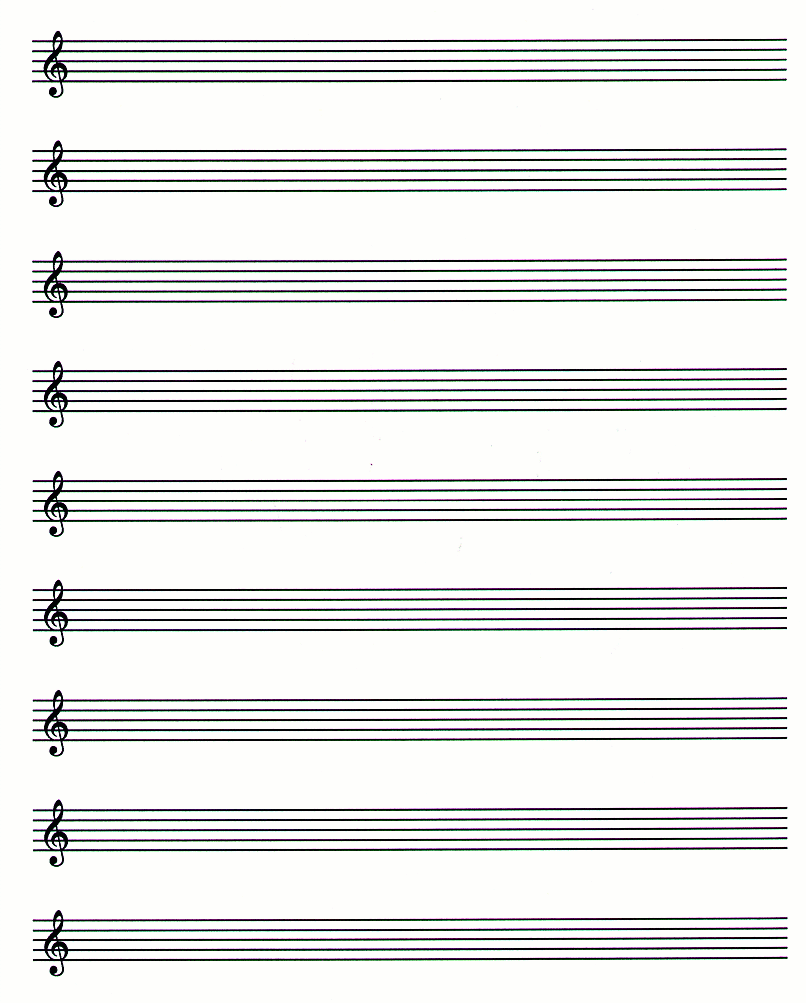 This image is of a sheet of manuscript paper. The staves here are the group of 5 horizontal lines placed parallel to each other. I took this image from the website http://www.cello.org/manu.htm which is a website available for downloading blank manuscript paper for writing your own scores/charts. This is something that I personally use a lot of the time to notate my parts for a brass section that I am playing in a cover performed by a vocalist. Most of the time, I notate phrases from my trumpet part as this is a way that I memorise my parts with ease.
I decided to research pitching because this could help my playing of Blue Bossa. At the start of the piece I play a G in the second octave which is followed by a note which comes shortly after which is the 3rd octave of G. Therefore, in this section it requires the technique of good pitching on the trumpet.
At the moment I can play the first two notes from the 2nd octave G and get up to the 3rd octave G decently so that the listeners will be able to hear both of the notes. Another error with this is that the 2nd G, which is the one in the 3rd octave, is slightly delayed after the first note and doesn't start on the right beat. I would still like to improve it so that I am more confident with reaching the higher notes after playing a much lower note. In other words, I would like to be more familiar with the changes(fast) that need to happen when I am playing low and high notes next to one another.
In this video, as evident I am playing the head melody with much better support than I did in the previous video which I showed earlier on in the blog.
The video of how I sounded before is in the video below.
In this video I am playing throughout the head melody of Blue Bossa. The timing is good, coming in at the right time, starting and ending phrases correctly with some syncopation at some points. (syncopation: features of jazz music research)
I didn't use any articulations with this piece which I will have to research but I assume because it's jazz, these can fluctuate through the piece as its is "imperfect"(articulation research)
Evidently, I should be more confident with playing the higher notes as sometimes they were split with lack of support. They would sound much stronger with more support on the air with more confidence on these notes.(link this with pitching)
I could also come up with some more imaginative ideas with this (link this to the second studio session)
Delays
Delays with getting a bassist, and therefore, having an incomplete rehearsal.
The song I will be recording is Blue Bossa who I need a bassist for. I printed out a chart each for the bassist and pianist. The only instruments in the song are the drums, piano and bass.
I chose to collaborate with a bassist who does not attend the college to play the bass for one of my songs Human Nature. My aim was to contact the bassist well in advance before the performance. The performance is on the 15th June and the auditions for the performance will be on the 22nd May which is two weeks away now. I would count the 22nd May as my deadline because that is when my song will be judged and it will be decided what performance my song will be featuring in. However, the bassist, Joshua has not been contacted yet and I have not asked him to play the bass for my songs. This is because I asked Joseph, who knows the bassist as a friend, to get through to him instead of contacting him directly. The major thing that is wrong here is the absence of a bassist for Blue Bossa which is an important part of the song. This now results in my rehearsals being delayed and having to come up with alternatives if it doesn't end up working out.
To solve this occurrence I will attempt to contact Joshua again and if it works out, we will plan to start rehearsing. It is also beneficial that he is an experienced player so to learn the part wouldn't take away a lot of time. It is possible to be that he could attend one rehearsal where I give Joshua the score, he could practice it in his own time and then on the second rehearsal he should know the part.
The song I will be performing live is Human Nature who I need a bassist for. I printed out a chart each for the bassist and pianist. The only instruments in the song are the drums, piano and bass.
A positive aspect of deciding my musicians for Blue Bossa was that they are all able to play the chart. The chart will be shown in the image below which is a PDF which I found by searching 'Blue Bossa Trumpet Cm' The other musicians (the pianist and bassist) will be playing in Cm while I play in Dm. The online PDF score consists of the trumpet part with the chords underneath. This is useful because the chords are correctly placed according to the parts and it will be easy for the musicians that can read music to know how each chord fits with my part with how it sounds.
(I am no longer using instrumentalists for my backing of Blue Bossa)
After a few weeks, this issue with the delays of getting a bassist was solved and now, he has been contacted and will be coming in for the first rehearsal shortly.

No comments:
Post a Comment